

Ophthalmologist
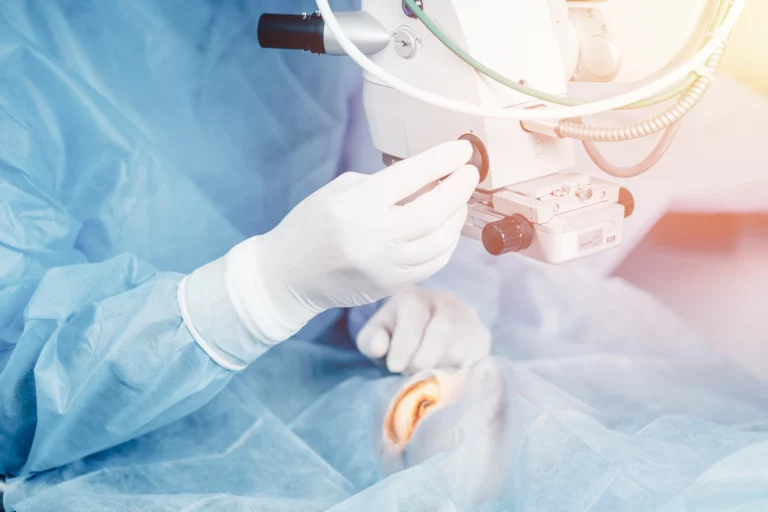
The principle is simple: the cornea, which is like a natural lens, can be slightly flattened or curved using a laser to modify the way in which light rays focus on the retina. With PRK, the laser acts directly on the surface of the cornea.
The intervention takes place in ambulatoryand the procedure is performed under local anaesthetic using eye drops. After removing the corneal epithelium (the thin surface layer of the cornea), the surgeon applies the laser to sculpt the cornea. At the end, a protective contact lens is fitted, to act as a dressing while the epithelium grows back naturally (a few days).
PRK has several advantages: it is suitable for thin or irregular corneas, where LASIK is not always possible. It also avoids certain complications associated with the corneal «flap» created by LASIK. On the other hand visual recovery is a little slower. It is often necessary to wait one to two weeks for comfortable vision to return, and sometimes one to three months for a completely stable result. During this period, slight discomfort or sensitivity to light may persist.
Complications are very rare, but as with any surgery, they can occur (dry eyes, night halos, residual corrections, infection (extremely rare))
After the operation, it is important not to rub the eyes intensely.
The long-term results are very satisfactory, comparable to those of LASIK. PRK is therefore an option reliable and safe for patients who want to be free of glasses, particularly if their eyes are not eligible for LASIK.
After refractive surgery, patients are advised to see an ophthalmologist annually for an ophthalmological examination.
We use cookies to guarantee you a better experience on our site.
Quality since 1985
With 40 years' experience, we have built our reputation on the quality of our service and the satisfaction of our customers.
